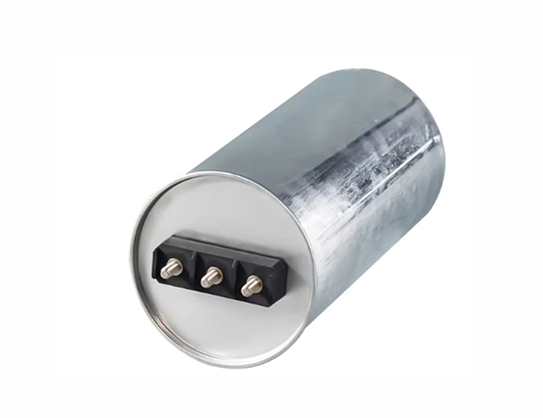
AC capacitor The core applications of AC capacitors are concentrated in filtering, coupling, bypass decoupling, reactive power compensation, motor starting and operation, all of which are essentially derived from their characteristics of "AC conduction, DC isolation" and capacitance impedance changing with frequency. Function of AC capacitors: 1. Direct current isolation: Capacitors allow AC signals to pass smoothly while blocking DC components. In a multi-stage amplifier circuit, it is used as a coupling to only transmit AC signals and not DC biases, avoiding signal distortion. 2. Filtering/bypass: This is the most commonly used function. Capacitors have low impedance to high-frequency AC and can short-circuit ripple and high-frequency noise to ground, making the output voltage smoother. For example, combining capacitors in the power circuit can reduce ripple from a few hundred millivolts to a few millivolts; Connect a 0.1 μ F small capacitor in parallel next to the chip power pin to specifically filter out high-frequency interference. 3. Energy storage and discharge: Capacitors charge and discharge quickly, and can release amplified current in microseconds. It's all thanks to it, like the flash suddenly discharging and the UPS losing power for a few milliseconds. It is also used in switch mode power supplies to store energy and meet the instantaneous high current demand of loads. 4. Phase shifting/motor starting: In single-phase motors (fans, water pumps, air conditioning compressors), capacitors are used to make the secondary winding current lead the main winding by 90 °, forming a rotating magnetic field before the motor can start and operate.